
This is a long one. Pour something. It is also, in the second half, a genealogical excavation. I offer it as search, not certainty — this is the family as I’ve been able to find it, through databases and DNA and death certificates and the work my cousins have done over years. Some threads may be wrong, or incomplete, or waiting for a record I haven’t found yet. And: I’m glad I ran that DNA test when I did. I’m not sure I’d give that data so freely now. The landscape has changed. But the richness it gave me — the names, the river valleys, the threads that confirmed the rumors — I wouldn’t trade that. Some doors, once opened, stay open.
The map on my wall was made for the French crown.
Partie Occidentale de la Nouvelle France ou du Canada — the Western Part of New France — drawn by Jacques-Nicolas Bellin, Ingénieur du Roy et de la Marine, to serve, as the cartouche says, the intelligence of the present state of affairs in America. Someone in Paris wanted to know what they owned. So they had it drawn.
My family is on it. They weren’t consulted.
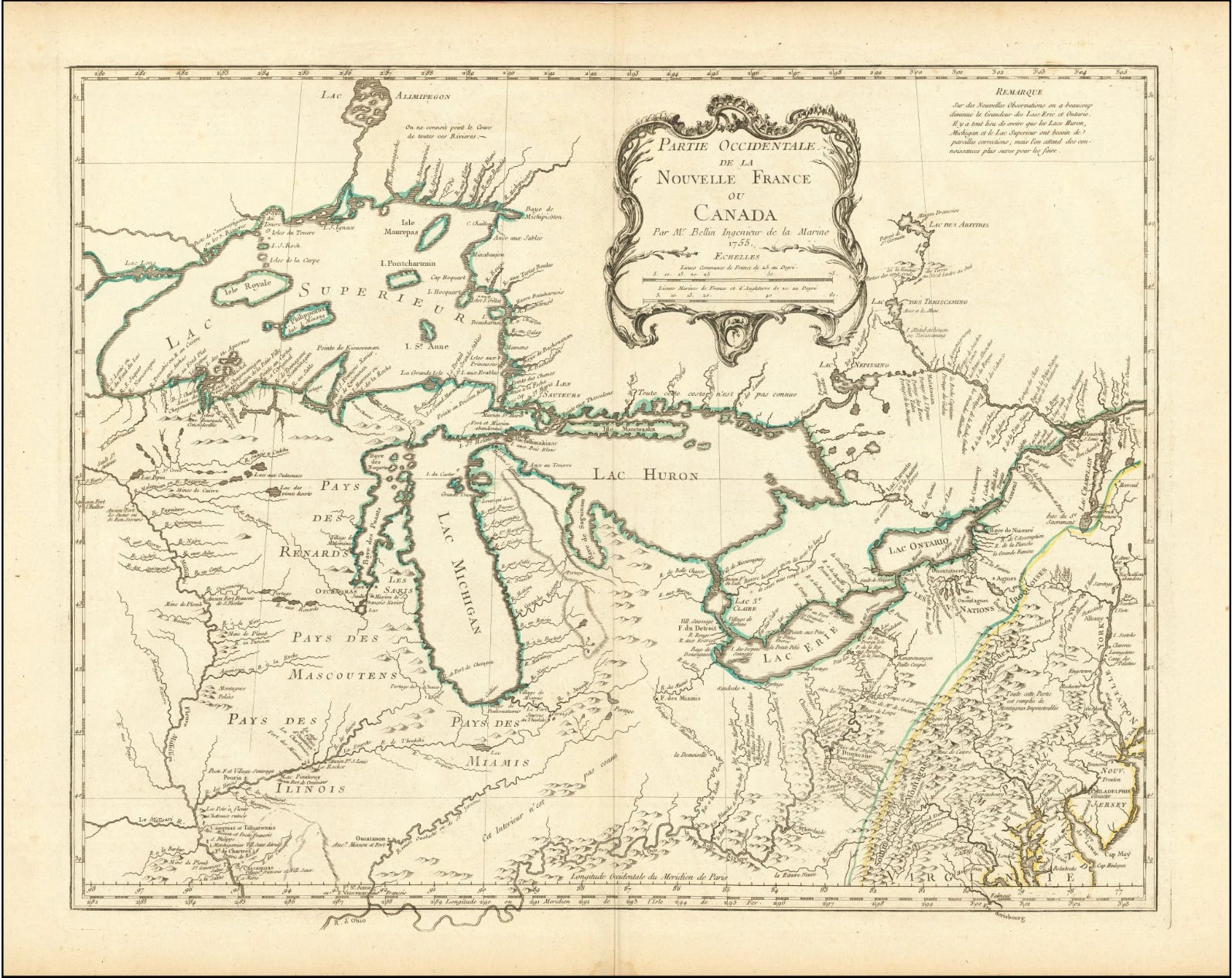
The Légers are somewhere in those river valleys — the Outaouais, the Gatineau — French settlers whose faces would eventually become legible on the streets of Detroit, whose name already carried Paris in it before they ever crossed the border into Michigan. And before the Légers, on that same river, a Huron Chief named Tsouhahissen, born 1775, my 5th great-grandfather, whose territory this map was made to describe for people who had never been there.
The map was made to serve the state’s intelligence. The state never fully grasped what it was mapping.
Faces and Names
My grandmother had strong Sicilian features. Dark eyes, particular bone structure, a face that carried the history of an island that has been Norman and Arab and Greek and Spanish and French and Italian, more or less in that order. Her name was Geraldine Rita Paris. Before that, Parisi. Her grandfather was Matteo — born Matteo Parisi, in Termini Imerese, a coastal city on the Tyrrhenian Sea forty kilometers east of Palermo. Matteo Parisi became Mathew Paris somewhere between Sicily and Michigan. A Sicilian family name, specific and rooted, carrying the sound of a village and a lineage, got flattened into a French city. The name survived. It lost its body. I only know it was Parisi because I went looking.
On my father’s side, the Légers came from the Outaouais River valley in Quebec. The DNA algorithm found them specifically — Outaouais French Settlers, La Vallée-de-la-Gatineau French Settlers. The map on my wall shows where they moved from. The DNA shows where they were before that.
My mother’s family came, in part, from Poland. From Silesia — that border region where the map kept changing depending on which empire was currently in charge, where your birthplace could be recorded as Poland or Germany depending on which year the clerk happened to be working from. Bartholomew (Bartek) Polk was born August 24, 1841 in Dembowa Góra — Oak Mountain — in Lubliniec, Poland. On April 18, 1855, when he was thirteen years old, his family boarded a ship called the Archimedes in Hamburg. They sailed to England, crossed to Liverpool, caught a ship to Quebec. They built railroads. They named their post office Cracow, after the royal city they’d left behind.
In 1866, Bartholomew married Tekla Galdeah Witkowski. She was seventeen. They had eight children in Paris Township, Michigan. Her name in the records: Tekla. Tillie. Takleah. Witkowski. Vitoske. Victorake. The country kept misspelling her into someone else.
Two Algorithms, One Set of Chromosomes
I took a DNA test. Years ago, through 23andMe. Later, I uploaded the same raw data — the same chromosomes, the same me — to Ancestry.com, which was then allowing users to feed their raw data into their own analysis system. Two different answers. Same DNA. Two machines. Two stories about who I am.
This is not a flaw in the science. The chromosome segments are real. What isn’t fixed is the labels. The categories being applied to the data are cultural and political constructs mapped onto biology. The algorithm was built by people who live inside the same national and ethnic categories we all live inside. So it organizes your chromosomes into the world as we’ve agreed to draw it.
Here is what both tests agreed on, more or less:
Approximately 39% various kinds of English — though the algorithm can’t decide which England, listing it across four distinct regional categories. 23% Italian, with Sicily listed separately because even the software knows Sicily is not quite Italy. 16% French Canadian — split between Quebec and Acadia. Acadia: the people the British deported. The original exile. 7% Central and Eastern European, which is where Tekla and Bartholomew live in the data. 3% Levant. 3% Nordic. 1% Donegal, Ireland. 1% Spain. 1% Egypt. 1% Indigenous Americas — Canada and United States. Nobody talked about that at the dinner table. The Levant didn’t come up either. Neither did Egypt. But they’re there. In both analyses. Some things are too stubborn to be organized away.
And then Ancestry found something specific: Southwestern Quebec French Settlers. Outaouais French Settlers. La Vallée-de-la-Gatineau French Settlers. The river valley on the map on my wall. The same geography where Tsouhahissen was born — the Huron Chief who is my 5th great-grandfather, whose line flows directly to me through eight documented generations. The DNA found him before I did.
Patriotism and the Better Flag
Recently I watched a video in which a journalist made the case for pluralism as a foundational American value. He was right about the history. Madison, Jefferson, the Establishment Clause, Federalist 51. Pluralism not as tolerance but as architecture: no default group from which permission flows, a society constituted of its many parts.
I agreed with him, in part. I also felt something uncomfortable that I had to sit with for a while before I could name it.
It still felt like being asked to pledge allegiance to a better flag.
Patriotism to a state makes me uncomfortable. I understand cultural belonging — I feel it, I live inside it, I carry it in my face and my name and the map on my wall. But loyalty to a government or its architecture is a different thing. One is horizontal — it runs between people, through kitchens and languages and the way certain faces mean something in certain cities. The other is vertical — it runs upward, toward an institution, toward a document, toward a flag. Even a good document. Even a better flag.
I don’t want a better flag. I want a conversation bigger than that.
Patriotism asks you to feel the real thing — the inherited, somatic, intergenerational belonging — and aim it at the state. But the feeling was never about the state. It was about the people and the place and the memory in your body.
I went to a Red Wings game at Little Caesars Arena after it opened. The Joe Louis Arena had been demolished. Inside the new building, they had been very careful to feature the heritage. The photographs. The retired numbers. The history on the walls. They knew what you came for. They were selling it back to you inside a building named after a pizza chain.
And I felt something walking in. Something real and embodied and inherited — something that lived in my chest before I could name it. None of that had anything to do with Little Caesars. I couldn’t cleanly separate the real feeling from the machinery harvesting it.
The community is real. The pride of place is real. The history is real. It is also being monetized. The workers who built Detroit and filled those seats for generations have largely been displaced by the same economic forces now selling them nostalgia for what was lost. It’s tangled. It’s supposed to be tangled. Anyone offering you a clean version of it is selling something.
Patriotism is the state’s attempt to capture the arena feeling and redirect it toward itself.
The tangled version — the one that holds the realness of the feeling and the corruption of the institution simultaneously — that’s the more honest place to live.
What No Flag Covers
Here is what no flag covers:
Matteo Parisi, from Termini Imerese, becoming Mathew Paris at a desk.
Tekla Galdeah Witkowski, married at seventeen in a place whose post office was called Cracow, spelled into four different names across a thirty-two year marriage.
Tsouhahissen, Huron Chief, born on the Outaouais River — whose bloodline became a family rumor, then a whisper, then silence, then 1% in a database, then a name found eight generations later.
Henri Membertou, Mi’kmaq Grand Chief, my 11th great-grandfather, who never ceded his land.
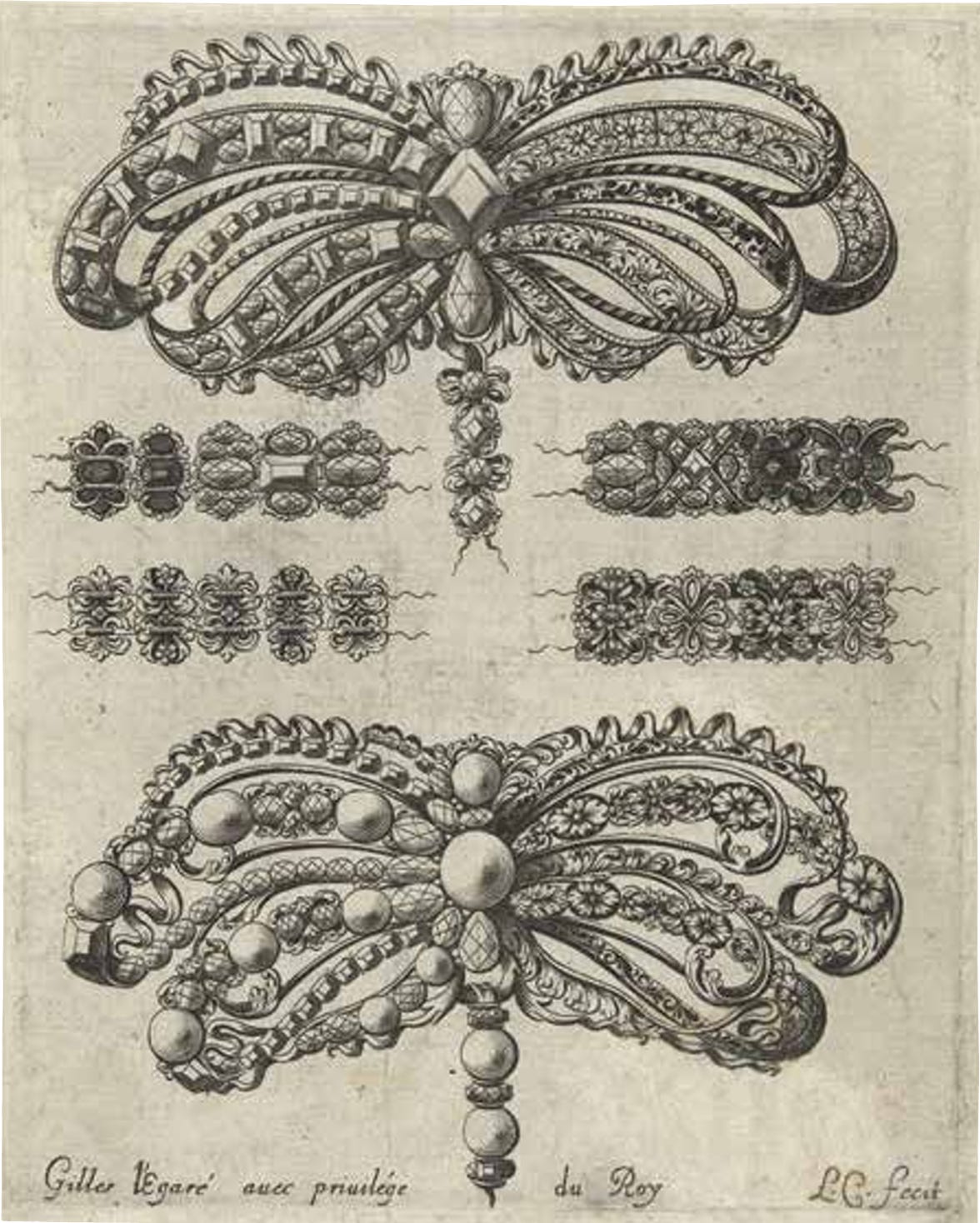
Gilles Légaré, who made a jewelry style fashionable enough to bear his name — à l’égaré, the lost bow — whose descendants crossed the ocean and became a face people recognized on Detroit streets.
Bartholomew from Oak Mountain, who sailed on the Archimedes, built railroads, cleared wilderness, fought for the Union, and died a laborer in Ecorse.
The river valley the algorithm found. The face my grandmother carried from Termini Imerese to Michigan. The feeling in my chest that had nothing to do with Little Caesars.
3% Levant. 1% Egypt. The parts that showed up anyway.
I am made of people whose names were changed and whose borders moved around them and whose faces carried histories that no single nation could claim. The DNA knows this even when the stories don’t. Two algorithms, one set of chromosomes, two different answers — which is the most honest thing they could possibly do.
You want me to feel patriotism. To aim the real, embodied, inherited thing I feel toward a government and its architecture. I feel what I feel. It lives in my chest and my face and my name and the map on my wall. It doesn’t fit in a flag. It never did.
The People the Map Didn’t Name
This is the evidence.
These are the people the map didn’t name — the ones whose lives the French crown was trying to make legible when it commissioned Bellin’s map of New France, and who were already there, already rooted, already carrying more history than any cartographer could hold.
I have 1,287 people in my genealogy database. What follows is not all of them. It is those who keep showing up in my thinking when I try to understand what belonging actually means.
The Lost Bow
My family’s name is a style.
Gilles Légaré — born February 25, 1617 in Chaumont-en-Bassigny, France, died October 18, 1663 in Paris — was a master jeweler to the court of Louis XIV. He invented a specific type of bodice ornament: a bow, so fashionable among the wealthy classes of the time that it was named after him. À l’égaré. The lost bow. The name Légaré, later Léger, meant something in Paris before it ever meant something in Detroit. It meant a man who made beautiful things for the Sun King. It meant craftsmanship precise enough to define a fashion.
Then some of them crossed the ocean.
Pierre Léger dit Parisien — Léger called the Parisian — born in Saint-Étienne du Mont, Paris, in 1650. The dit name followed them: Parisien. Léger from Paris. The family already carried the city in their name before any of this became about Michigan or Detroit or the face people recognized on the street. They were the Légers from Paris. Even in the river valleys of Quebec, even after the ocean, they were still Parisian.
The Léger family’s dit name was their city of origin. This matters because of what happens on the Sicilian side: Matteo Parisi becomes Mathew Paris. Two different families, two different continents, both carrying Paris when they end up in Michigan. The Sicilian name that got flattened into a French city, and the French family whose nickname was already that city. I don’t know what to do with that coincidence except note it. Genealogy is full of moments where the threads seem to have been aiming at each other all along.
What I keep coming back to is this: the Légers were craftsmen before they were settlers. They made things precise and beautiful enough to bear their name. Then their descendants crossed the ocean and became French Canadian farmers and eventually became a face that people recognized on the streets of Detroit. The craft didn’t come with them — or if it did, it didn’t survive in a way that left a record. What survived was the name. And the dit name: Parisien. And the face.
Tsouhahissen
The Léger family always heard rumors.
First Nations ancestry, passed down as whisper, never confirmed, never named out loud. The kind of thing that gets mentioned once and then not again. Because naming it had consequences. Because the story of who your family was had to fit the story the community was telling about itself — French Canadian Catholic. Not Huron. Not Mi’kmaq. Not Indigenous anything.
And so the rumor circulated, and the generations passed, and the faces carried what they carried, and nobody said the names.
Until I ran a DNA test.
Huron Chief Andre (Adam) Romain. His Wendat name: Tsouhahissen. Born 1775 in Pays d’en Haut, on the Outaouais River, Quebec — the same river the DNA algorithm had already identified as my family’s place of origin. The same river on the map on my wall. He married Marie Jeanne Picard Okouandoron, also identified in the records as Huron Native. Their son Augustin Romain was born 1795 in Quebec.
Eight generations from Tsouhahissen to me:
Tsouhahissen (1775–1815)
Augustin Romain (1795–1856)
Marguerite Romain, identified as Native (1836–1881)
Henriette Blondine, identified as Native (1858–1937)
Beatrice Isabella Marion (1890–1969)
Albert Clovis Foch Léger (1919–2013)
John Bernard Léger (1955– )
Heather Marie Léger
Notice where the Native identification stops appearing in the records. Marguerite: Native. Henriette: Native. Beatrice: nothing. Albert: nothing. John: nothing. Not because it stopped being true. Because assimilation happened, generation by generation, name by name, until the Chief became a rumor and the rumor became silence.
And there is Henri Membertou — Grand Chief of the Mi’kmaq, my 11th great-grandfather. The first Indigenous person in North America to be baptized Catholic, in 1610. A man who navigated the arrival of European settlers with extraordinary political intelligence — who chose alliance strategically, who maintained Mi’kmaq sovereignty as long as he could, who died in 1611 having never ceded his people’s land.
His daughter Jeanne Marie Kagigoniac — explicitly identified in the records as Mi’kmaw, daughter of Chief Henri Membertou — married into the French Acadian settler community. Her line flows forward through the generations and eventually arrives at the Léger line in Quebec.
Membertou is 1% in a database. He is also one of the reasons I exist.
The tree is full of women whose names were recorded in two registers simultaneously: their French Catholic name, and a notation — Native, Mi’kmaq, Huron, Abenaki, Algonquin — that tracked what the church and the colony were trying to absorb. Catherine LeJeune, born 1633, listed as Mi’kmaq. Edmée Aimée, listed as Métis — Mi’kmaq, Abenaki, Algonquin — born 1622. Marie Demouet, or Kapiouapnokoue, or Oukabe, born 1667 in Quebec City. Adelaide Brisebois Native, born 1809. Marie Louise Olivier Native, born 1765.
Their descendants became French Canadian. The notations stopped. The faces carried what they carried.
I think about what it means that the DNA found Tsouhahissen before I did. The algorithm looked at my chromosomes and said: Indigenous Americas, Canada and United States. It couldn’t tell me his name. It couldn’t tell me about the Outaouais River or the eight generations or the rumors. It just saw the pattern in the data and reported it.
The river knew. The DNA knew. The family whispered it for generations.
The flag didn’t know. The flag never asked.
Henri Membertou died in 1611 having never ceded his land. The land was taken anyway, in the ways that land gets taken. The Mi’kmaq are still there, in Nova Scotia, in the Maritimes, on the land he never signed away. And some of his descendants are also here — in Florida, in Michigan, in a body that carries 1% Indigenous Americas in two different databases.
Parisi
Sicily has been conquered by nearly everyone. The Greeks. The Arabs — who ruled for two centuries and left a permanent mark on the language, the architecture, the food, the DNA. The Normans. The Spanish. And then Italy — unified in 1861, which meant, as Sicilians have always understood, that the island simply acquired a new set of administrators.
Sicilian identity persists through all of this not because it was protected but because it was too specific to be fully absorbed. The island knows what it is. It has survived too many flags to be defined by any of them.
Giovanni Parisi was born around 1820 in Messina, Sicily — the northeastern corner of the island, across the strait from Calabria. His son Matteo was born in September 1843 in Termini Imerese, a coastal city on the Tyrrhenian Sea forty kilometers east of Palermo, where thermal springs have drawn people since antiquity, where the Mascari family had been documented since the 1680s.
The Mascaro family came from a different place: Serrastretta, in Calabria — the toe of the Italian boot, across the strait from Sicily, a different mountain culture, a different dialect. They arrived in Termini Imerese and married into the Sicilian families there. Matteo Parisi married Elizabeth Guideci. Her name preserved in parentheses in some records: (Guideci) Paris. A notation that the original name existed, that there was a before.
Their son Frank Paris married Sonta Mascaro — born 1900, died March 18, 2002, age 101. She saw the entire twentieth century. Her daughter was Geraldine Rita Paris.
My grandmother Geraldine carried the Parisi line in her face and in the way she moved through a room, long before I knew the word Termini Imerese. Her faith saturated the house — images of saints, a Virgin in the yard, rosary always nearby, hymns under her breath.
She sang with the Sweet Adelines, barbershop harmony for women, voices stacked in perfect alignment, chords shaped like braided light.
She had a way of holding still that made things come to her — not just small creatures, but people who needed to settle. She lived open and attuned, without needing recognition. That stillness — I know it in my own body. I know where it came from.
There is another photograph: her wedding day, October 23, 1943 in Detroit. All lace and satin and curls, one hand over her new husband’s — my Grandpa Léger — as they cut the cake. Around them: plates, cups, half-eaten meals, generations bearing witness. The Sicilian girl from the Paris family and the French Canadian boy from the Léger line, whose bloodline ran back through Tsouhahissen to Henri Membertou. Sicily and the Outaouais River, meeting in Detroit.
They had fourteen children. She outlived two of them. She kept going.
When family members questioned my choices — why I wasn’t married yet, why I hadn’t followed the expected script — she stepped in every time. “Heather is picky,” she’d say, with a softness that cut through shame. She saw me. She defended me. Every single time.
That’s what I carry from Termini Imerese. Not just the bone structure. The stillness. The way of holding open. The refusal to let shame settle.
Sicily teaches a particular relationship to flags. When you have been ruled by this many people, when your island has been claimed by this many crowns, you develop a practiced indifference to the official story of who you belong to. The official story changes. The springs at Termini Imerese stay. The dialect stays. The food stays. The face stays.
You belong to the place. Not to whoever currently holds the flag over it.
Oak Mountain
On April 18, 1855, a family boarded a ship called the Archimedes in Hamburg.
They came from Dembowa Góra — Oak Mountain — in Lubliniec, in the Silesian region of Poland. Silesia was complicated. It had been part of Poland, part of the Holy Roman Empire, part of Prussia, and would eventually become part of Germany, and then part of Poland again. The border moved around the people. The people stayed on their land and watched the flags change.
The Polk family — Francis and Josephine and their children, Bartholomew among them at age thirteen — sailed from Hamburg to England, crossed to Liverpool, caught a ship to Quebec. They did not speak English or French. In Canada, they built railroads — the Grand Trunk Railway, pushing west toward the American border. They lived in shacks along the track, moving with the work. A brother was born in Paris, Ontario — a town named after the gypsum deposits that resembled those near Paris, France, which had nothing to do with France except the name. They heard there was cheap land in Michigan’s Thumb. On September 16, 1856, Francis Polk purchased eighty acres for fifty cents an acre, forty dollars total, in Paris Township, Huron County, Michigan. They named their post office Cracow — after Kraków, the city of kings, the seat of Polish culture. They were in Paris Township, Michigan, getting their mail at Cracow. Both names borrowed. Both names pointing somewhere else. The people pointing toward home.
In 1861, Bartholomew Polk enlisted in the Union Army. Company D, 12th United States Infantry. He had been in America for six years. He may not have spoken English fluently. He filed an invalid pension in 1886 — wounded or disabled in service. The country gave him a pension application and spelled his name differently on every document.
In 1866, Bartholomew married Tekla Galdeah Witkowski in Huron City, Michigan. She was seventeen years old.
Her name in the records:
Tekla Polk — 1870 census, Paris Township, age 21, occupation housekeeper, birthplace Poland, post office: Cracow.
Tillie Polk — 1880 census, age 31, wife, Paris Township.
Tillie Takleah Witkowski-Vitoske — the divorce record, Wayne County, 1898.
Telkla Victorake — Michigan death records.
One woman. Four names. Each one a different clerk’s attempt to hold something that kept slipping through the official categories.
Tekla is a saint’s name — Saint Thecla, first-century martyr, one of the earliest Christian women remembered by name. It traveled from the early church through Eastern Europe and arrived in Silesia and was given to a girl born around 1849 in Poland, who at seventeen married a man from Oak Mountain and had eight children in a place called Paris whose post office was called Cracow.
In 1898, the divorce was recorded. She had been his wife for thirty-two years.
She outlived him. He died January 7, 1918 in Ecorse. Occupation: laborer. Cause of death: gastric carcinoma. Father’s birthplace: Germany. Because Silesia was complicated and the clerk didn’t know the difference.
Tekla disappeared from the official record the way many immigrant women did — present in everyone else’s documents, absent from her own. Her children became Detroit people. Peter Polk: machinist at Ford Motor Company. John, Robert, Sofia, Agnes, Anna, Alexander, Mary — all of them living into the mid-twentieth century, scattered across Detroit and Wayne County. The wilderness their parents cleared became the factory floor their children worked on. The post office called Cracow became the Ford Motor Company.
He came from Oak Mountain. He sailed on the Archimedes. He built railroads. He cleared wilderness. He fought for the Union. He died a laborer.
He gave the country his body. The country recorded his birthplace wrong. He was my mother’s grandfather.
Boadway
Mary Charlotte Hughes was born on April 5, 1888, in Moore Township, Lambton, Ontario. Her father died when she was about one year old. She grew up without him, raised by her mother in the flat farm country near Lake Huron. By seventeen, she was already married to Robert Spurgeon Boadway and living in Saskatchewan — already far from home, already following the westward pull that was remaking the interior.
They moved again, to Creston, British Columbia — a valley where fruit trees grow heavy in the summer. They had four children. In 1917, their three-year-old son died. Six months later, Alice was born into that house. Mary Charlotte was twenty-nine.
She died on March 7, 1920. Thirty-one years old. Buried in Creston. Her husband crossed into Michigan seven months later with the children. Alice was two.
She grew up without her mother, the way her mother had grown up without her father — the loss so early it doesn’t arrive as memory, just as structure. Something missing that becomes the shape of everything.
And still: she grew things.
Alice Isabel (Boadway) Polk, my maternal grandmother, grew grapes on arbors and raspberries on canes. She put the summer up in glass. After she died, the jars moved to an attic in Florida, and the family ate from them for years. She was already gone and still feeding people.
No one told her that Creston was a valley of orchards. No one taught her how. The knowledge came anyway.
This is what I mean when I say belonging doesn’t organize cleanly.
The map didn’t record this. The records don’t explain it. The flag has no category for it.
But the body remembers what the archive cannot hold.
Detroit
They all came to Detroit.
The Légers from the Outaouais River valley, whose faces became legible on the city’s streets over generations. The Polks from Oak Mountain, whose children became Ford workers and Ford machinists. The Parisis from Termini Imerese, who brought my grandmother’s face and her stillness and her way of holding open. All of them moving toward the same city, from different directions, for different reasons, in different decades, arriving and staying and putting down whatever roots the century allowed.
Detroit was a city that absorbed people. That was its function, in the industrial era: to take the children of immigrants and turn them into autoworkers. To make Americans out of people who had been Polish and Sicilian and Huron and French Canadian, by giving them a job on the line and a house in a neighborhood and a team to root for.
My grandmother Geraldine Rita Paris married Albert Clovis Foch Léger on October 23, 1943 in Detroit. Sicily and the Outaouais River in one photograph, cutting a cake, generations bearing witness. Their son John Bernard Léger was born March 2, 1955. He carries Termini Imerese and the Outaouais River and Henri Membertou in his face. He doesn’t know all of it. Most of us don’t.
The Léger family’s belonging to Detroit was real. It was earned in the specific way belonging gets earned: by being there, by showing up, by having children and grandchildren who were also there, until the faces meant something to the street. That’s not patriotism. That’s just time and presence and the slow accumulation of a life in a place.
Bartholomew Polk’s belonging to America was also real. He earned it by fighting for it, by building it, by clearing the wilderness and working the line and dying a laborer in Ecorse. And the country gave him a pension application and spelled his name differently every time and recorded his birthplace as Germany.
The feeling is real. The country is imprecise.
Here is what the map on my wall shows me now, that it couldn’t have shown the French crown when it was made:
That the territory it depicts was never empty. That the river valleys had names before the Ingénieur du Roy drew them. That the people who lived there were not subjects to be managed but lives being lived — Huron lives, Mi’kmaq lives, Acadian lives, French Canadian lives, Polish Catholic lives, Sicilian immigrant lives, all of them converging on a city called Detroit that would eventually be named after a strait, le détroit, by the same French military man who built a fort there in 1701.
Two years before the map was made.
The threads were always moving toward each other. The map couldn’t see it coming.
I said that I don’t want a better flag. That I want a conversation bigger than that. This is what I mean. The conversation bigger than a flag is the one that can hold Tekla Galdeah Witkowski and Tsouhahissen and Gilles Légaré and Matteo Parisi and Bartholomew Polk and Mary Charlotte Hughes and Alice Isabel Boadway and Geraldine Rita Paris and all the unnamed women in the tree — the Mi’kmaq women, the Huron women, the Abenaki women, listed with their French Catholic names and the notation Native — simultaneously, without having to choose which one defines the whole.
Patriotism can’t do that. Patriotism picks a flag and asks you to organize your belonging around it. But my belonging is distributed across at least six centuries and four continents and 1,287 people who show up in a genealogy database. It cannot be organized. It can only be witnessed.
That’s what I’ve been doing here. Recovering what got smoothed away. Naming what got misspelled.
Parisi. Tsouhahissen. Tekla. Boadway. Légaré.
They were always there.
The map just never named them.
The flag was never made to hold them.
I learned a lot from this! Thanks for sharing it. It is amazing how so many different people, places, and cultures make up you and I.